



Favourite Treat
The moment a salty plum hits your tongue, something happens. A sharp burst of salt, a wave of sourness, then a quiet sweetness that lingers.The first taste can catch you completely off guard. By the third one, your hand is already reaching back into the bag.
But salty plum is not just a flavour hit. It is a 3,000-year-old story that crossed oceans, survived colonial trade routes, and landed right here in Gordonvale, Queensland. Since 2017, TSG Gordonvale has been sharing that story one bag at a time.
Tracing the Origins of Salty Plum
The cultural story of salty plum does not begin in a convenience store. It begins around 3,000 years ago in ancient China, where preserved plums, known as Suanmeizi (酸梅子), were used as a medicinal ingredient long before anyone thought of selling them in a bag.
Traditional Chinese medicine practitioners prescribed them to settle the stomach, relieve nausea during travel, and combat heatstroke during hot summer days. The plum’s natural acidity and high salt content made it practical in an era without refrigeration. It became one of the earliest examples of food preservation used as medicine.
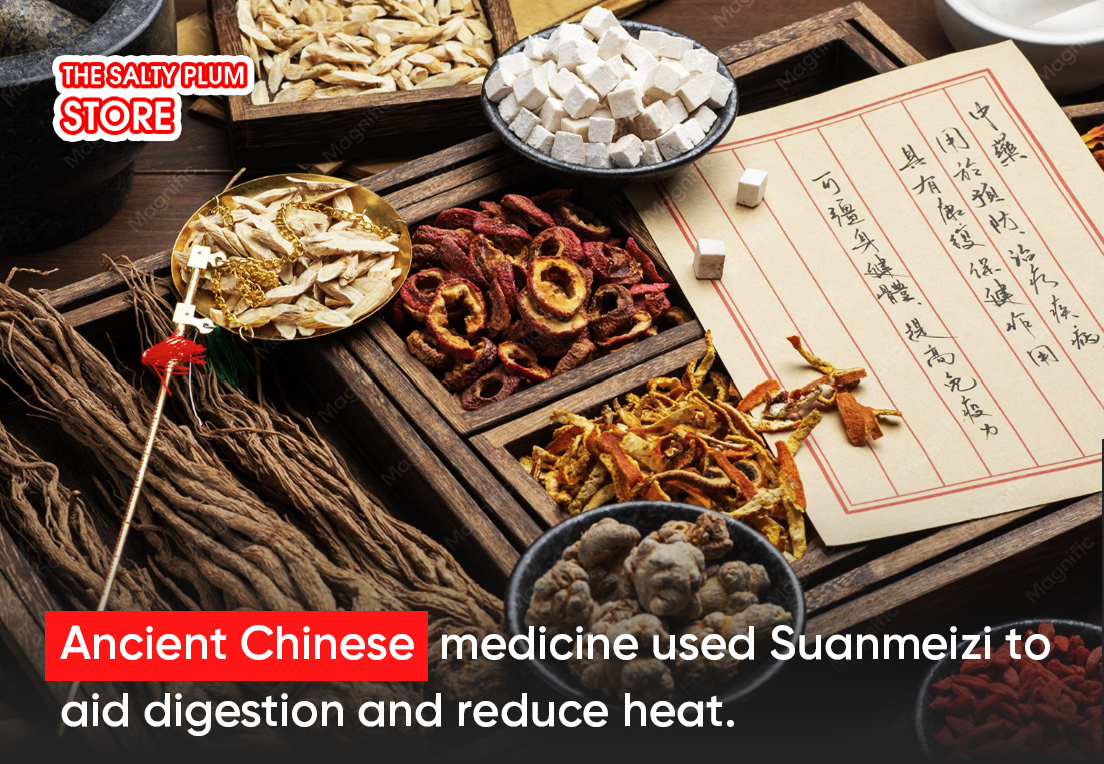 Ancient Chinese medicine used Suanmeizi to aid digestion and reduce heat.
From the Imperial Kitchen to the Street Corner
By the Tang Dynasty (618–907 AD), salty plum had moved from the medicine cabinet into the imperial kitchen. Historical records from the period describe Suanmei Tang, a sweet-and-sour plum drink served at the royal court as a summer refreshment. What began as a remedy had evolved into a luxury.
Over time, the knowledge spread throughout Asia. In Vietnam, it became Xí Muội, a tart salted plum traded along coastal routes and sold by street vendors. In Japan, a parallel tradition developed independently with Umeboshi (梅干し), a salt-pickled plum that samurai carried into battle as a portable energy source. Taiwan and Hong Kong later developed dozens of regional variations, each with different levels of salt, sweetness, and spices such as liquorice, ginger, or chilli.
The science behind salty plum’s effectiveness is surprisingly simple. The combination of sodium and citric acid helps replenish electrolytes, stimulate saliva production, and activate digestive enzymes. Long before modern sports science existed, Asian cultures had already discovered its benefits.
The “Salty Plum” Habit: A Cultural Signature Across Asia
Walk past any primary school in Vietnam, Hong Kong, or Taiwan on a weekday afternoon and you will likely find a vendor with a plastic tray of salty plum outside the school gate. That single image captures the cultural story of salty plum perfectly.
For hundreds of millions of people across Asia, salty plum is not just a product. It is a memory.
 Street vendors selling Xí Muội outside schools are common in Vietnam.
The Taste of Childhood
In Vietnam, children mix Xí Muội with green mango slices or dissolve it in water to create a tart drink. In Hong Kong, office workers keep tins of preserved plum in desk drawers as an afternoon pick-me-up. In Taiwan, salty plum is pressed into thin sheets and sold as Huamei candy designed specifically for children.
The flavour profile activates five of the six flavour receptors simultaneously: salty, sour, sweet, umami, and bitter. Neuroscience research into flavour complexity suggests that foods with strong flavour contrast activate the brain’s reward system more intensely than single-note flavours. This is one reason salty plum feels genuinely addictive.
Yin-Yang on Your Tongue
In traditional Chinese dietary philosophy, foods are categorised according to energetic properties such as cooling or warming, contracting or expanding. Preserved plum is considered a “sour-cool” food. It is believed to contract Qi (energy), cool the body during heat, and stimulate the flow of saliva and digestive fluids.
That is why salty plum is commonly eaten after rich or oily meals across Asia. It is not only about taste. The cultural belief system also supports it as a digestive aid. The balance between salty and sour reflects the broader Yin-Yang principle of harmony in food.
A Gift Worth Giving
Salty plum also plays an important role in social rituals throughout Asia. During Lunar New Year, families exchange boxes of premium preserved plums, especially varieties from Taiwan and Hong Kong presented in decorative packaging.
In Cantonese culture, offering salty plum to a guest is considered an act of care. It carries the meaning: “I want to settle your stomach and make you comfortable.”
This social significance helps explain why premium gift boxes of salty plum are popular at TSG Gordonvale. They are not simply snacks. They represent a cultural gesture passed down for centuries.
How Salty Plum Conquered the Australian Outback
The cultural story of salty plum in Australia is closely tied to migration, particularly the waves of Asian migration into Northern Australia from the 1850s onward.
Chinese workers who travelled to the Northern Territory and Queensland during the gold rush era, and later as sugar cane labourers, brought their food traditions with them. Salty plum, being practical and shelf-stable, travelled easily in their luggage. It eventually found a natural home in the tropical heat of Darwin, Cairns, and the Queensland coast.
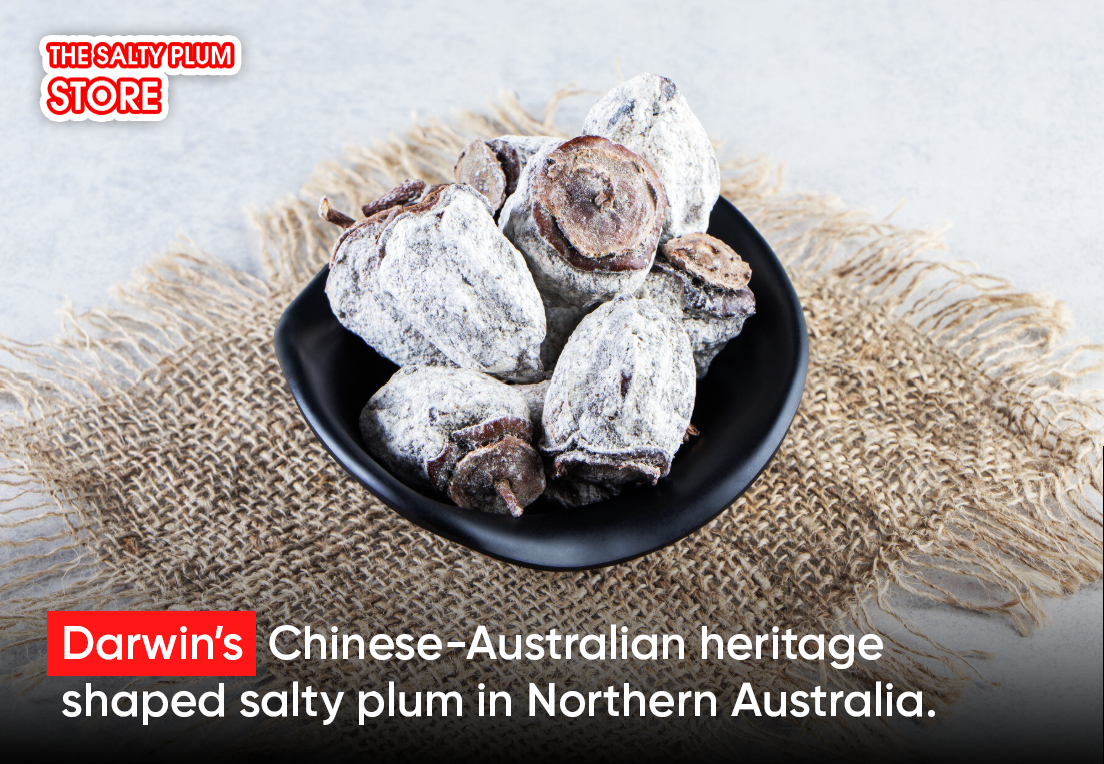 Darwin’s Chinese-Australian heritage shaped salty plum in Northern Australia.
The Darwin Effect
Darwin became one of the first gateways for salty plum into mainstream Australian culture. By the mid-20th century, corner stores in Darwin’s Chinese precincts stocked multiple varieties. Non-Asian Territorians began buying them out of curiosity, but also because the salt content made them effective in extreme heat.
Over time, the tradition expanded further down the coast. In Cairns and the Atherton Tablelands, where humidity and temperatures closely resemble Darwin’s climate, salty plum found another loyal audience. Gordonvale, located 25 kilometres south of Cairns, became a natural fit for the same tradition.
Why the Tropical Climate Drives Demand
The human body loses sodium rapidly through sweat in temperatures above 30°C. Salt cravings in hot climates are physiological signals from the body.
Salty plum naturally responds to that craving by delivering sodium, citric acid, and a sharp flavour that stimulates salivation. In many ways, it follows the same principles as modern electrolyte drinks sold in sports stores across Queensland, except salty plum has been doing it for more than 3,000 years.
Gordonvale’s diverse community, including strong Vietnamese, Chinese, and Southeast Asian populations alongside long-term Australian residents, created the perfect environment for salty plum to thrive. TSG Gordonvale opened in 2017 to meet that demand with a carefully curated range that general grocery stores could not match.
How to Choose the Right Salty Plum for You
This is where the cultural story of salty plum becomes practical. TSG Gordonvale carries multiple varieties, and choosing the right one can feel overwhelming if you are new to the category.
By Flavour Profile
If you want intense salt with minimal sweetness
Choose a Taiwanese or Hong Kong variety. These are salt-forward, umami-rich, and have a firmer dried texture. They pair especially well with beer or work as a palate cleanser.
For a smoother mix of sweetness, tartness, and saltiness
Choose a Vietnamese Xí Muội style. These are softer, slightly sticky, and more rounded in flavour. They are ideal as a standalone snack or dissolved in water as a drink.
If you want the authentic preserved plum experience (Umeboshi style)
Look for Japanese-origin varieties. These are intensely sour, moderately salty, and have firm flesh. They work best with rice dishes, marinades, or as a digestive aid after meals.
If you want something with chilli heat
Ask the TSG Gordonvale team about the chilli-salted varieties. These are especially popular with long-term Gordonvale customers and work beautifully in salty plum soda.
Conclusion: Every Salty Plum Has a Story — Go Find Yours
The cultural story of salty plum spans three millennia, four continents, and more flavour variations than most people will experience in a lifetime. It travelled from Chinese imperial courts to Vietnamese school gates, then to Darwin corner stores and finally onto the shelves of TSG Gordonvale. Every step of the journey was carried by people who found something essential in its taste.
If you have never tried salty plum before, come in and explore. The team at Shop 2, 76–86 Gordon Street can help point you toward the right starting point. If you already know what you like, there is a good chance TSG Gordonvale has something new waiting for you.
Call (07) 4056 1561, email info@tsggordonvale.com, or visit in-store any day of the week. The full story is already on the shelf. All that is left is for you to pick up a bag and add your own chapter.
Related Article:
Best Places to Buy Asian Dried Fruits in Cairns & Gordonvale: A Local Foodie Guide
Best Asian Dried Fruits in Cairns & Gordonvale: Where to Buy & What to Try
How to Choose High-Quality Dried Fruits (Avoid Cheap Products)